


Fusiliers and the American War of Independence
5th Regiment of Foot

The 5th Regiment of Foot, later known as the Royal Northumberland Fusiliers, arrived in Boston in 1774. The Regiment played a significant role in two key events: the battle of Lexington and Concord, the conflict that marked the beginning of the war, and the brutal battle of Bunker Hill.
Lexington and Concord
When the 5th arrived in Boston the city was simmering with tension. Just a few months earlier, tea shipments had been destroyed in Boston Harbour in a dispute over import duties – an event that became known as “the Boston Tea Party”. As part of the crackdown on the rebellious colonists, the British government introduced a series of measures known as “Intolerable Acts”, closed the port of Boston, dissolved the colonial assembly, and placed Massachusetts under military rule.
After reports that colonists were stockpiling weapons in the nearby town of Concord, British commander Major-General Thomas Gage ordered his forces to investigate on 19 April.
But Patriot colonists had been tipped off about the British search, and an advance column of British forces was met by Patriot militia at Lexington Green. Shooting broke out and eight militiamen were killed. The skirmishes that took place that day triggered the war and were memorably described by the poet Ralph Waldo Emerson in 1837 as “the shot that was heard around the world”.
British forces pressed on to Concord but failed to locate any weapons. Meanwhile more Patriot militiamen continued to arrive. The British were pressured into a fighting retreat with the column repeatedly ambushed as it withdrew along the roads to Boston.
British reinforcements, commanded by Colonel Hugh Percy, were waiting at Lexington and fired on the pursuing militia. Percy was an experienced officer and Colonel of the 5th Foot. The men under his command covered the British retreat to Boston. The British soldiers were forced to march the 40 miles (64km) without stopping, all while under fire from an often-unseen enemy.
The events were disastrous for the British government, marking the point a colonial revolt turned into a struggle for political independence. It also proved that homegrown militiamen could stand against well-trained British soldiers, especially if using guerilla tactics.
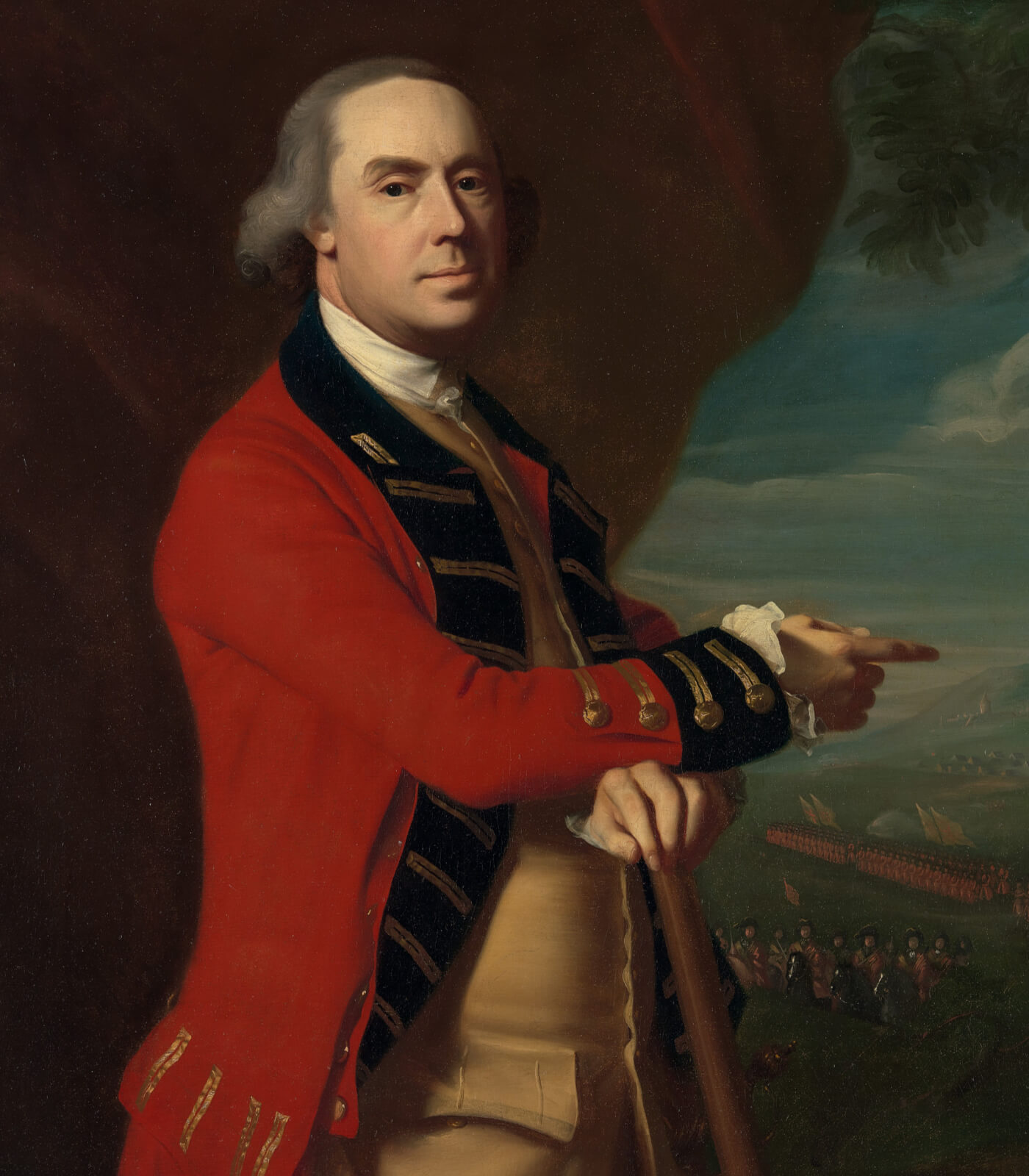 General Thomas Gage, by John Singleton Copley 1788, Yale Center for British Art, Paul Mellon Collection
Bunker Hill
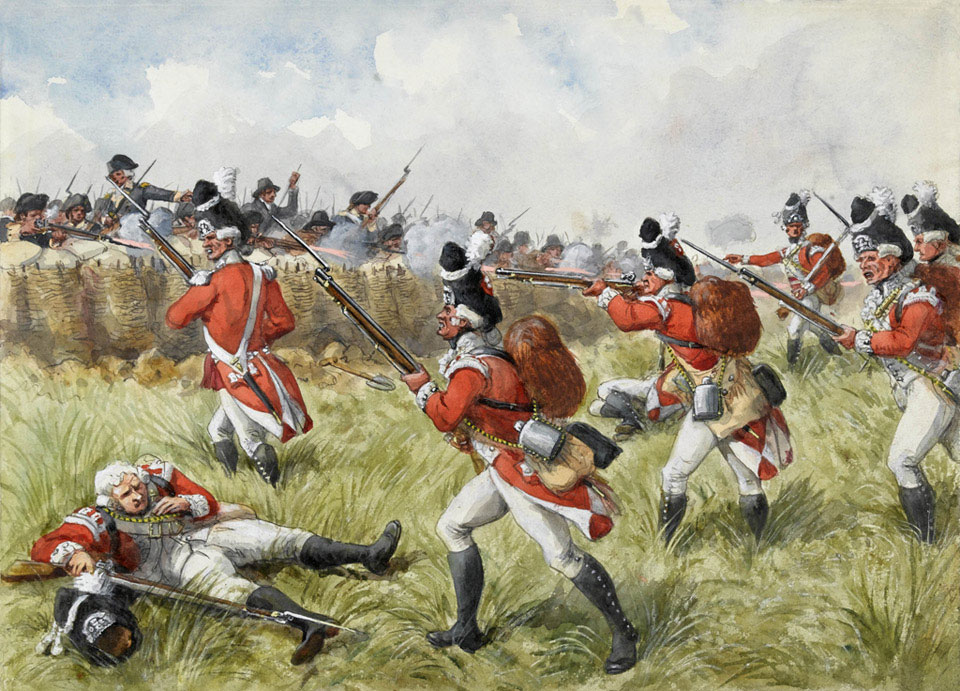 Bunker Hill, Watercolour by Richard Simkin, 1900 (c). National Army Museum
Within a few days thousands of militiamen from across New England laid siege to Boston. After British reinforcements arrived by sea, Major-General Gage determined to defeat the Patriot forces outside the city. He drew up a plan with the recently arrived generals William Howe, John Burgoyne and Henry Clinton. On 17 June, British troops were ferried to Charlestown Peninsula, just across the river from Boston, where militia forces had gathered. The conflict that ensued was the first pitched battle of the war and became known as the Battle of Bunker Hill.
Patriot militia from Massachusetts, Connecticut and New Hampshire were eventually defeated, but the British fought an uphill battle, with more than 1,000 soldiers wounded or killed. This accounted for a more than a third of the British force taking part and were the worst losses of any single battle in the war. The 5th alone had more than 135 wounded and about 20 killed. Militia casualties were estimated to be half that of the British.
Proclamation of Rebellion
In August, when news of Lexington and Concord and Bunker Hill reached Britain, King George III issued the Proclamation of Rebellion which authorised a British military response to the uprising.
The costly victory at Bunker Hill helped to shape British strategy during the war and prompted the hire of German auxiliaries, or Hessians, to boost their numbers. For Patriot forces, it spurred on the newly-formed Continental Army - led by General George Washington.
The 5th Foot went on to take part in the capture of New York, fighting in the Battle of Long Island and the Battle of White Plains in 1776. It was part of the campaign to capture Philadelphia and fought in the Battle of Brandywine Creek in 1777.
The following year the Regiment was sent to the West Indies, along with other infantry regiments, to challenge French forces on St Lucia. By now the France had declared its support for the Continental Army. British forces of 1,400 faced a French army of 9,000 at St Lucia, but this time they were dug in on high ground and emerged victorious. About 400 French soldiers were killed and more than twice that figure wounded.
Regimental history records that after the battle, men from the 5th Foot took white hat plumes from fallen French soldiers and placed them as trophies in their own hats. This is the origin of the modern Regiment’s white and red hackle. The Regiment returned home from the West Indies in 1780.
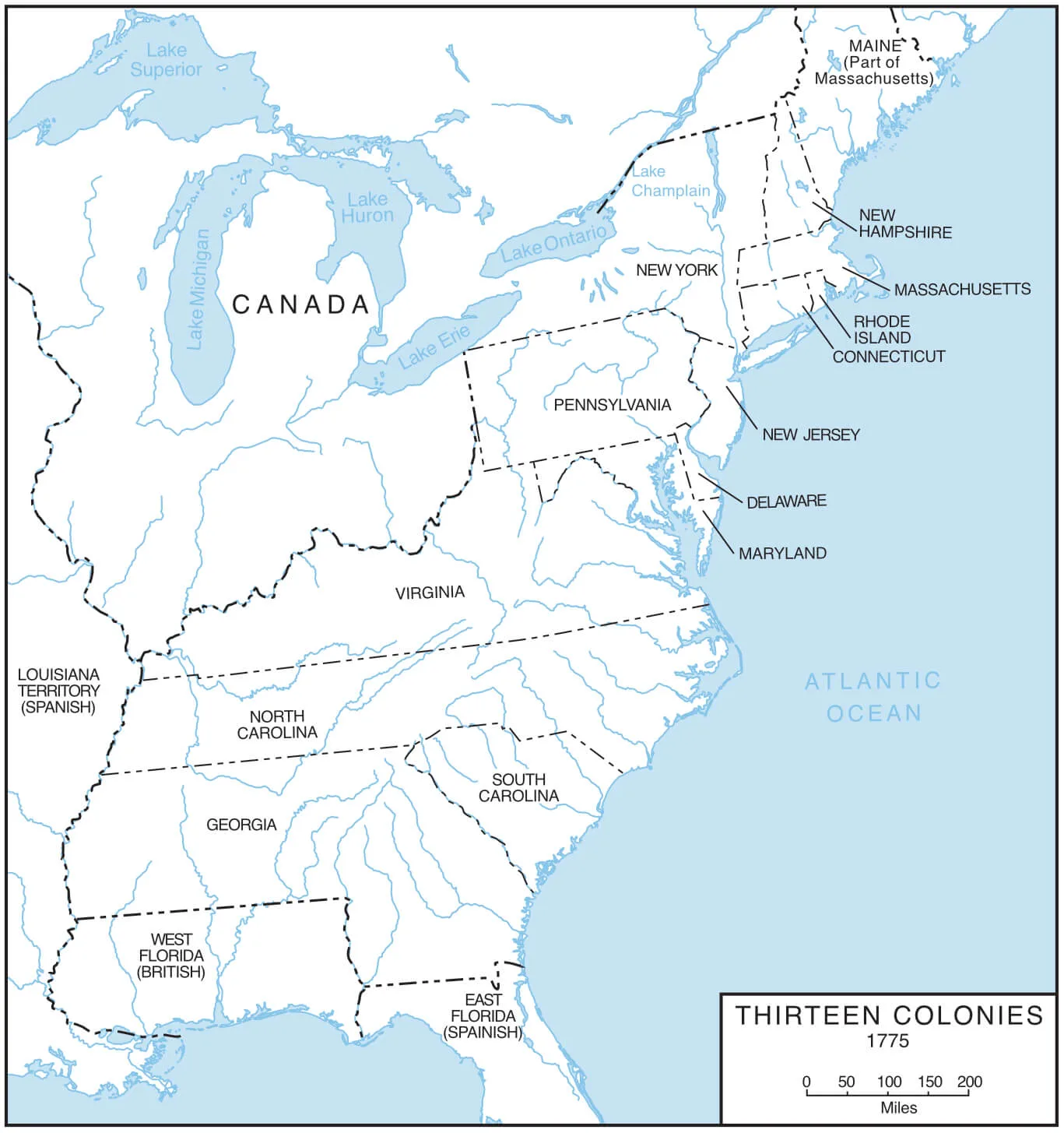 A map of the British Thirteen Colonies at the end of the colonial period in 1775. Courtesy of the U.S. Army Center of Military History