


Fusiliers and the American War of Independence
7th Regiment of Foot

The 7th Regiment of Foot, later known as the Royal Fusiliers, was the first British regiment to have its colours captured during the war. Six years later, a defeat at the Battle of Cowpens in South Carolina resulted in the loss of its colours for a second time.
Invasion of Quebec
When war broke out in 1775, the 7th was already garrisoned in the British colony of Quebec. A mission to invade Quebec was led by the Continental Army’s General Richard Montgomery, a former British army officer. His first task was to capture Fort Saint-Jean, the main defensive fort that protected Montreal. This proved difficult as it was well defended by several hundred British soldiers from the 7th and the 26th Regiments.
After some local intelligence, Montgomery switched his attention to a smaller fort a few miles upriver from Saint-Jean where just a single company of the7th was garrisoned; about 80 or so soldiers and several officers. Montgomery’s men, assisted by Canadian forces, surrounded the fort. After several days’ siege, the British commanding officer Major Joseph Stopford, reluctantly surrendered. He knew his company was vastly outnumbered, and the fort could not withstand a heavy artillery attack. There were also about 100 women and children in the fort. In fact, in his letter to Congress, Montgomery wrote about the British: “Their number of women and their quantity of baggage is astonishing.”
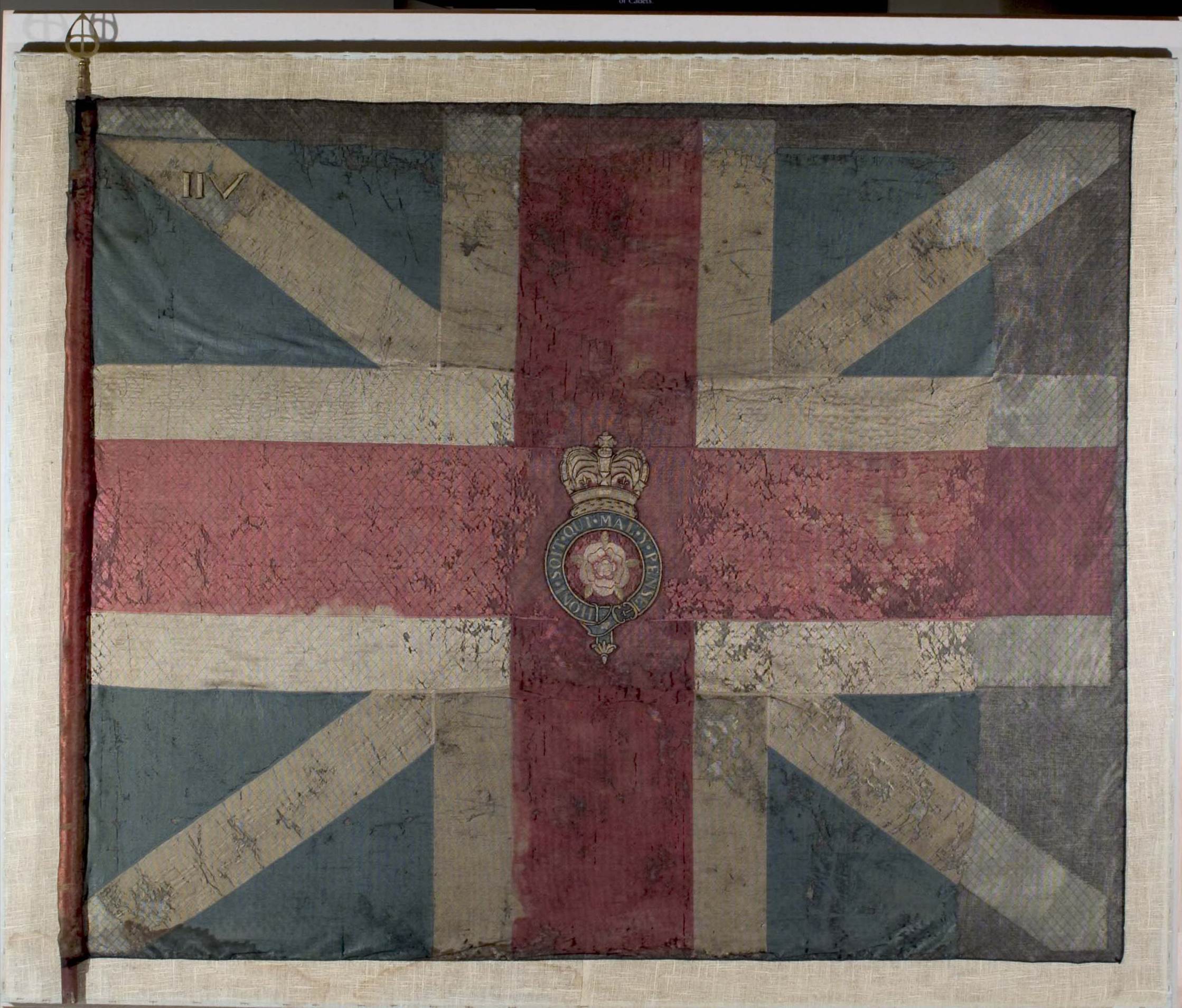 The King’s Colour of the 7th Regiment of Foot, captured at Fort Chambly in 1775. Courtesy West Point Museum Collection, United States Military
Prisoners of war
The company became prisoners of war but were allowed to leave the fort with all their personal belongings. The Regiment’s colours were left behind, possibly by accident. These were the first enemy colours to be captured by an American army and are now displayed at West Point Museum in the US.
Montgomery used the British supplies seized at Fort Chambly, which included about six tons of gunpowder, to capture Fort Saint-Jean. Another 400 or so British troops became prisoners of war, many of them from the7th. Montgomery went on to invade Montreal, forcing the British Governor of Quebec, Lieutenant General Carleton, to retreat to Quebec City. Montgomery was joined by Continental Army generals Benedict Arnold and Daniel Morgan, and they laid siege to the city. It was here their luck ran out: their attack on the city in December 1775 was a disaster. Hundreds of Continental soldiers were killed, Montgomery among them.
British forces in the city, including the last remaining free company of the7th, put up a fierce defence. Morgan was captured, along with hundreds of Continental Army soldiers. Arnold blockaded the city for another five months with diminishing resources. British reinforcements arrived from England in May 1776, including the20th Regiment of Foot. The Continental forces retreated, leaving behind their supplies and abandoning their invasion plans.
In another blow to Congress, a British raid on a fort close to Montreal, captured 400 men. These prisoners were swapped for the nine companies of the7th and the men of the 26th who had been seized at forts Chambly and Saint-Jean the previous year. By December 1776, the 7th was in New York, resuming active duties.
One of those freed prisoners was Major John Andre of the 7th. Andre went on to become head of British intelligence operations, but in 1780 he was captured behind enemy lines. He was carrying documents that detailed General Benedict Arnold’s defection and plot to surrender the fort at West Point. Andre was hanged for espionage on the orders of General Washington. Even some Patriots disagreed with the severity of his sentence. His death triggered widespread mourning in Britain and King George III erected a monument to Andre in Westminster Abbey.
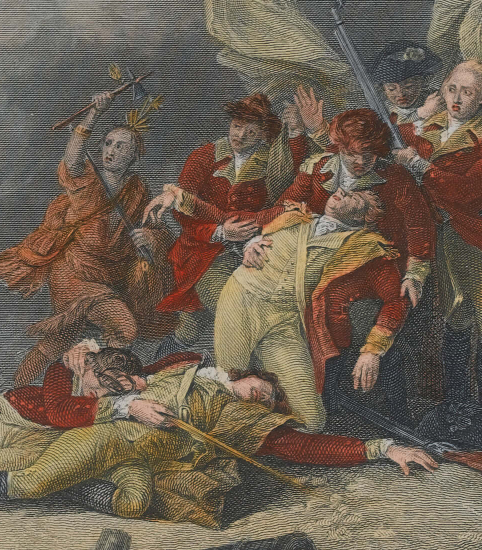 Death of General Montgomery, 1775. Coloured line engraving by J Trumbull, 1775 (c), published by Samuel Walker, Boston, 1800 (c).National Army Museum
Southern Campaign
As the Northern Campaign in the colonies began to falter, and both France and Spain joined the war in support of Continental forces, the British began to focus on the southern colonies where it was thought there was more Loyalist support. In 1780 the7th was sent south, with a large contingent of both army and naval forces under General Clinton and his second in command, Lieutenant-General Cornwallis. After a six-week siege, British efforts resulted in the capture of Charleston, in South Carolina. It was an important British victory and one of the worst losses for Continental forces during the war. To swell their ranks, the British promised freedom for enslaved people working for Patriots, if they joined the British. This strategy alienated some Loyalists in the south and the expected support for the British never materialised.
It was in South Carolina in early 1781 that the7th suffered its biggest defeat of the war. En route to aid a besieged fort in Georgia, about 200 men and officers from the 7th were ordered to report to Lieutenant Colonel Banastre Tarleton, a young British cavalry commander. They were to track down the retreating Continental Army’s General Daniel Morgan. Tarleton attracted fierce loyalty from his Legion of Loyalists and was well regarded by Cornwallis, but he was also accused of being impulsive and cruel to enemy troops.
Tarleton decided to attack Morgan at a site in South Carolina known as Cowpens, despite the exhaustion of the infantry who had endured a long march. The7th was in the first line of infantry and as the Continental forces appeared to retreat, they were ordered to pursue. But this was a trap devised by Morgan. The Continental forces turned and instead began a fierce counterattack. British forces were boxed in and faced heavy fire. Estimates for the number of British killed vary between 100 and 300, with about 500 captured. Some reports suggest the Continental Army lost fewer than 20 men. Tarleton was blamed by some for the defeat.
The men of the 7th were either killed or taken prisoner. The Regiment’s colours were captured, although accounts suggest not from the battlefield, but instead discovered in baggage. Cowpens was the last major battle the 7th fought during the American War of Independence. Those taken prisoner were released at the end of the conflict, returning home in early 1783.
